
Meet Raghavasimhan Sankaranarayanan’s robotic violinist — ‘Hathaani’


Raghavasimhan Sankaranarayanan
| Photo Credit: Special Arrangement
Meet ‘Hathaani’, a robotic violinist created by Chennai-born engineer-musician Raghavasimhan Sankaranarayanan. The name Hathaani reflects Raghavasimhan’s childhood passion for Carnatic violin and robotics. ‘Taani’ is derived from the Tamil taaniyangi, which means automated machine or robot, and ‘Haath’ or hands is from Sanskrit/Hindi, he says.
Raghavasimhan was initiated into violin at age four by Kunnakudi Vaidhyanathan, and later learnt from Trichy Srinivasan and T. S. Rajagopalan. A disciple of A. Kanyakumari for the past 18 years, Raghavasimhan says, “Rajagopalan sir’s strict practice regimen deepened my love for the instrument, while Kanyakumari amma enhanced my expressive ornamentation and nuances of musicianship.”
It was during his Master’s Studies at Georgia Tech, US, that ‘Hathaani’ began taking shape. Raghavasimhan, whose first performance was at age eight and who has collaborated with several musicians, says, “I presented a simple demo of the fingerboard of the violin. My advisor Gil Weindberg was impressed. I continued expanding my research through my PhD on ‘Applications of AI and Robotic Musicianship in South Indian Classical Music’.
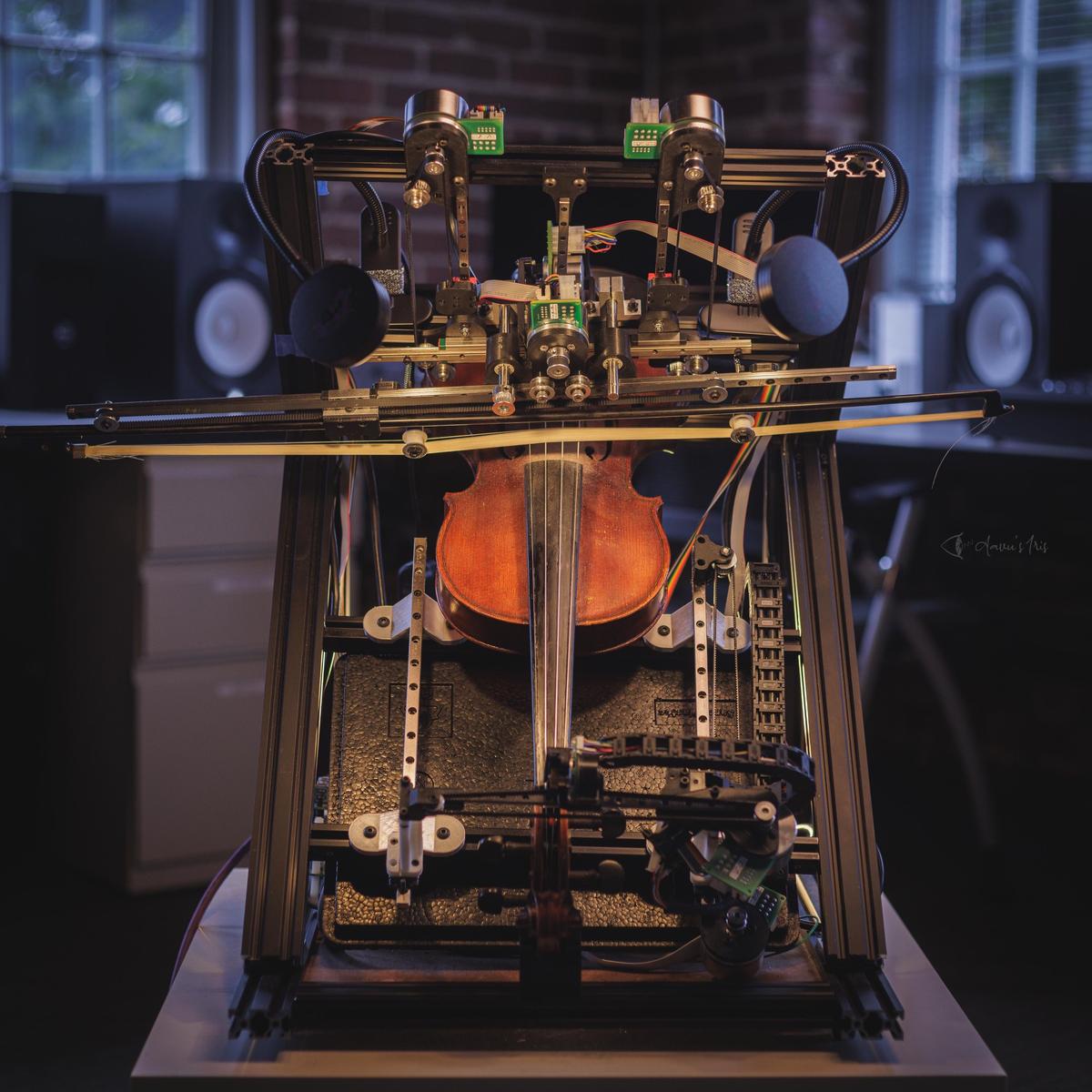
The Hathaani
| Photo Credit:
Raghavasimhan Sankaranarayanan
The physical structure evolved over years of testing. Raghavasimhan says: “The first version was played on a single string. I soon covered all four strings and adjusted its posture to closely resemble a Carnatic violinist for better tone and stage presence.” Creating musical intelligence required new datasets and new AI modelling techniques. “Training AI needs a lot of data, and Carnatic music datasets are limited,” he notes. To teach ‘Hathaani’ the nuances, he relied on live recordings of varnams rendered by violinists Embar Kannan and Rangapriya Sankaranarayanan, vainika Anjani Srinivasan, and keyboardist Vigneswar VG, along with precise note-level annotations. “I chose varnams as they have a uniform structure between lineages. I pre-processed the audio recordings and annotations in a way that the AI model can understand them.”
‘Hathaani’ has been tested both in the laboratory and in the presence of musicians, including S. Sowmya, Ganesh Rajagopalan, Ramesh Vinayakam,and Embar Kannan, as well as research peers at Georgia Tech. “Their feedback on the gamakas’ rendition, artistic perspective and technicalities was incorporated,” shares Raghvasimhan.
“The goal of Hathaani is to complement human artistry, serving as an educational aid and inspiring collaborative performances that bridge technology and tradition,” adds Raghavasimhan.
Raghavasimhan recalls AR Rahman visiting their laboratory. “He featured Hathaani on a big screen during his live show in Atlanta, and his appreciation meant a lot.” What next? “Maybe, a performance next year with musicians,” he says.
Published – December 06, 2025 10:33 pm IST